 CairoVolt Team
Vape 18650 External Charger Importance — Why Charging via Mod is Dangerous
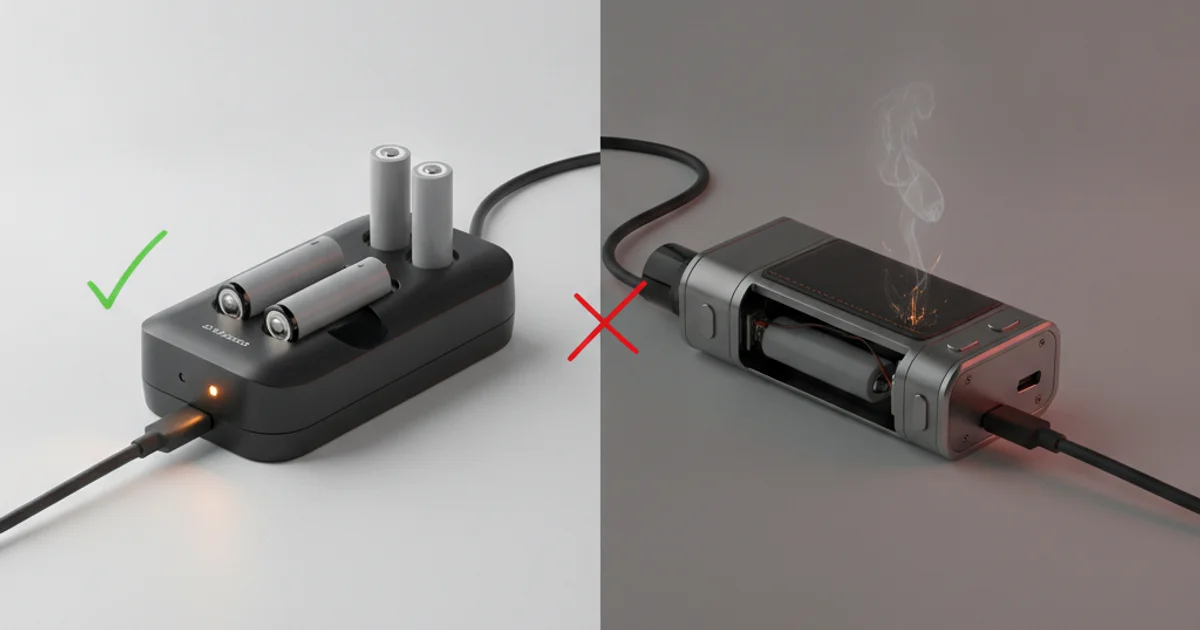
Charging your 18650 vape batteries using the mod's built-in USB port is the quickest way to fry its circuit board and degrade the cells. Here is the technical explanation.
In short: Charging 18650 vape batteries inside the mod carries risk for 3 reasons: there is often no cell balancing, so one cell can be overcharged; heat builds up next to the control board; and the mod's USB port wears out over time. A smart external charger (such as Nitecore or Xtar) monitors each cell separately and protects against overcharging.
Vaping has grown exponentially in Egypt. With the widespread adoption of high-wattage dual-battery mods (such as Vaporesso or Drag devices), many users opt to charge their 18650 batteries directly inside the device via the integrated Type-C or Micro-USB port. While this port appears convenient, charging high-drain cells internally is an engineering hazard. Direct charging is the primary cause of fried chipsets, warped casings, and degraded cell chemistry. Here is the detailed technical guide on why you should never charge batteries inside your mod, and the critical importance of dedicated external smart chargers.
💡 Quick Answer: Charging 18650 batteries inside your mod lacks active cell balancing and generates excessive heat that destroys delicate chipset solder joints. A dedicated external charger (Nitecore or Xtar) is the safer way to charge and balance high-drain lithium cells.
1. The Engineering Danger of Cell Unbalancing in Dual-Battery Mods
Most dual-battery vape mods wire cells in series to achieve the high voltages needed to heat low-resistance coils at 80W or above. When charging through the mod, the internal charge circuit treats the two cells as a single, combined battery bank:
- If Cell A has slightly degraded (having higher internal resistance) and sits at a lower voltage (e.g., 3.8V) while Cell B is healthy at 4.2V.
- The mod's basic charging circuit continues pushing current to reach the targeted series potential of 8.4V.
- This results in Cell B being overcharged beyond its safe chemical limit (exceeding 4.35V) while Cell A remains undercharged.
- Overcharging a high-drain lithium cell causes lithium plating, breaking down the separator, generating gas, and risking a catastrophic thermal runaway (explosion).
2. Mod Chipset Degradation and PMIC Thermal Stress Heuristics
Modern vape mods house high-performance microchipsets (such as DNA, GENE, or AXON chips) that regulate voltage, read coil resistance, and manage current delivery. Charging dual 18650 batteries at 2A generates significant heat. Unlike laptops, vape mods lack passive heat sinks, cooling fans, or venting paths designed for continuous charging heat loads.
This heat radiates directly into the nearby chipset and solder joints. Over time, the thermal cycling dries out and cracks the solder joints (dry joints), leading to component separation. This manifests as screen errors, inaccurate resistance readings ("Check Atomizer"), or a completely fried motherboard.
3. 18650 Cell Chemistry, Overcharge Thresholds, and SEI Growth
High-power vape mods demand specific battery chemistries to handle extreme current draws safely:
- Lithium Manganese/Nickel Cores (IMR / INR): These are the standard for vaping (e.g., LiMn2O4). They have extremely low internal resistance and boast high thermal stability, meaning they do not vent violently under short circuits.
- Lithium Cobalt Cores (ICR): Standard LiCoO2 cells offer high energy density but low current output. They are highly volatile under load and should never be used in vapes, as high-current draws lead to prompt thermal runaway.
Lithium chemistry dictates a strict charging cutoff limit of 4.20V ± 0.05V. When charged internally by low-grade mod circuits, the cell can easily be overcharged to 4.5V, forcing metallic lithium to precipitate as microscopic dendrites that pierce the internal safety separator, causing a catastrophic internal short circuit. Overcharging also accelerates Solid Electrolyte Interface (SEI) layer growth on the anode. This thickens the internal resistance, creates severe electrochemical hotspots, and permanently destroys the battery's capacity and current-carrying capability within weeks.
4. Mechanical Fatigue of Vape Mod USB Ports
The USB port on a vape mod is surface-mounted to the internal PCB by microscopic copper pins. Since vape mods are heavy Zinc-alloy blocks, connecting a cable and constantly lifting, setting down, or knocking over the device applies a large mechanical lever force to the tiny solder pads.
This physical fatigue eventually shears the pins off the PCB pads. This can lead to intermittent charging, or cause loose pins to short-circuit, permanently bricking the mod. Charging your batteries externally completely avoids mechanical wear on this fragile connector.
5. The Nature of Unprotected 18650 High-Drain Cells
Unlike standard 18650 cells used in flashlights, vape batteries are high-drain cells (INR, IMR, or ICR chemistries like LG HG2, Samsung 25R, or Sony VTC6) designed to discharge continuous currents up to 25A or 35A.
To enable these massive currents, these cells are unprotected—meaning they lack an integrated Protection Circuit Board (PCB) at the positive terminal. A standard protection PCB would trip under the high current demand of a vape mod. Because these batteries lack internal failsafes, they rely entirely on the charging device to prevent overcharging or short-circuiting. The basic charging circuit inside a mod is insufficient for this task, whereas dedicated external chargers are built specifically for it.
6. How External Smart Chargers Mitigate Safety Risks
Dedicated external chargers from reputable manufacturers (such as Nitecore, Xtar, or Golisi) feature dedicated microprocessors for each independent charging bay. They safeguard your batteries through several mechanisms:
- Independent CC/CV Charging: Each cell is monitored and charged individually according to its own voltage curve, switching from Constant Current (CC) to Constant Voltage (CV) and tapering current as saturation approaches.
- Active Voltage Balancing: The charger ensures both cells reach an identical 4.20V state of charge before they are placed back in the mod, preserving balance and doubling overall battery lifespan.
- Internal Resistance Auditing: Smart chargers measure cell internal resistance in milliohms. If a battery is fake, damaged, or aging, the charger flags it with an error ("Err") code, letting you know it is no longer safe for high-drain vaping.
- Reverse Polarity Protection: If you place a battery in backward, the charger cuts power to that slot immediately, preventing shorts and sparking.
7. Battery Storage and Transportation Safety Guidelines
One of the most dangerous, yet common mistakes in Egypt is carrying spare 18650 batteries loosely in pockets or bags alongside keys, coins, or loose change. If a metallic object bridges the positive and negative terminals of an unprotected cell, it creates a hard short circuit.
This short circuit draws massive currents immediately, heating the cell to hundreds of degrees and causing a violent venting or explosion inside the user's clothing. Always carry spare batteries in a dedicated plastic case (Battery Case) or a silicone sleeve to prevent accidental contact with foreign metal objects.
8. PVC Wrap Damage and Short-Circuit Hazards
The entire steel body of an 18650 cell serves as the negative terminal (-), while the small top cap is the positive terminal (+). The only barrier preventing a short circuit is a thin plastic PVC sleeve (the battery wrap) and a small paper insulator ring at the top. Inserting and removing batteries from tight mod bays can easily scratch or tear this wrap. The paper ring at the positive terminal is especially critical; if it falls off, the positive cap can short directly to the nearby negative shoulders under pressure. Using or charging a battery with a damaged wrap inside a metal mod invites disaster. The exposed negative steel casing can contact the mod frame or spring contacts, causing a hard short circuit. This draws hundreds of amps instantly, leading to thermal runaway and venting within seconds.
Inspect your 18650 wraps daily. If you spot a tear, nick, or missing top insulator ring, do not place it in a charger or mod. Purchase inexpensive replacement PVC wraps and apply them using a standard hair dryer on a warm setting to re-insulate the cell.
9. External 18650 Charger Price Guide in Egypt 2026
| Charger/Cell Type & Specs | Popular Brand Series | Approximate market range in Egypt (2026) |
|---|---|---|
| Dual-Slot External Charger | Nitecore New i2 / Xtar MC2 Plus | 450 to 600 EGP |
| Quad-Slot External Charger | Nitecore D4 / Xtar VC4SL / Golisi S4 | 850 to 1200 EGP |
| Authentic 18650 Battery Cell (Single) | Samsung 25R / Sony VTC6 / LG HG2 | 200 to 350 EGP |
The USB port on your vape mod is intended primarily for firmware updates and rare emergency charging. Investing in a dedicated, certified external charger is a practical way to extend your hardware's life and charge more safely.
CairoVolt Team
Tech Editor
Frequently Asked Questions
Can charging my vape through the mod damage the device?▼
What is an unprotected 18650 cell?▼
What should I do if my battery wrap is torn?▼
Which external charger brands are recommended?▼
Ready to Buy?
Browse available products and review specifications and CairoVolt warranty terms before ordering