
Smartwatch for Elderly Parents — 6 Health Features That Must Be Present Before You Buy
Not every smartwatch is suitable for elderly parents. A guide to real health features — from fall detection to emergency alerts — and what is actually available in Egypt at a reasonable price.
TL;DR: A smartwatch for elderly parents should have continuous heart-rate tracking, sleep tracking, a large clear screen, 3+ days of battery and clear vibration alerts for calls and messages. Real fall detection exists in Apple Watch and Galaxy Watch at much higher prices. The practical alternative: Joyroom FT3 at EGP 1,092 — a 1.85-inch screen and 4 days 7 hours measured battery, but no fall detection and no microphone for calls.
Your father or mother has passed 60 — may they stay in great health. But you know that every day you spend at work, you are constantly worried: Did something happen to them? Did they fall? Is their blood pressure spiking while their phone is in another room and they are not answering? This is not a dramatic movie — it is the reality in every Egyptian household with an elderly parent alone for at least 8 hours daily.
So you find yourself searching "smartwatch for elderly" on Google — and get 500 results all selling you a "health watch that measures blood pressure and detects falls" for 200 EGP. And as an engineer — or even as a rational human being — you know that a real blood pressure sensor (Oscillometric cuff) requires mechanical pressure on the artery, not a green LED on the back of a plastic watch. So let us separate the real from the fake.
In this article, we will explain exactly: what health features actually matter for elderly people, what genuinely exists in smartwatches versus marketing claims, and what the best options available in Egypt are across different budgets.
💡 Quick Answer: A smartwatch for elderly parents needs: 24/7 heart rate sensor + abnormal heart rate alerts + sleep tracking + large screen + 3+ day battery + loud notifications. Real fall detection = Apple Watch or Galaxy Watch (approximate market range 7,000+ EGP). Practical alternative in Egypt: Joyroom FT3 at EGP 1,092 — a large screen and 4 days 7 hours measured battery, without fall detection or a microphone for calls.
The First Truth — "Measures Blood Pressure" Is a Marketing Claim on Most Watches
Let us start with the most dangerous marketing claim in the smartwatch market: "blood pressure measurement." Most cheap watches you find on Amazon or OLX that claim to "measure blood pressure" use an Estimation Algorithm based on PPG waveform analysis — not actual blood pressure measurement.
This difference is not academic — it is the difference between life and death for elderly people. Imagine the watch telling you your father's blood pressure is 130/85 "normal" — while the actual reading is 180/110 and he needs emergency care immediately. FDA-cleared blood pressure devices use a pressurized cuff on the arm or wrist — not a small optical sensor.
Very few smartwatches are medically certified for blood pressure at all. The Samsung Galaxy Watch 4/5/6 estimates it optically but still requires calibration every 28 days with a real cuff-based device — and its blood-pressure feature is CE-marked and enabled in 30+ countries (it is simply unavailable in the US, not limited to South Korea). A handful of watches go further with an actual built-in cuff: the FDA-cleared Omron HeartGuide and the CE- and NMPA-certified Huawei Watch D use a real inflatable cuff, which is more medically legitimate than any cuffless optical estimate. Even Samsung does not tell you "we measure blood pressure from nothing" — they say "we estimate it after you calibrate with a real device."
⚠️ Important Warning: Do not rely on any smartwatch as a substitute for a medical blood pressure device. "Blood pressure" readings from cheap watches (under 2,000 EGP) are typically inaccurate by ±15-30 mmHg — a margin that could cause you to ignore a genuine hypertensive crisis.
The 6 Essential Features for an Elderly Smartwatch — Ranked by Importance
After removing the "blood pressure measurement" claim from the list — let us focus on features that genuinely save lives and make a daily difference for elderly people:
| # | Feature | Why It Matters for Elderly | Available Under 2,000 EGP? |
|---|---|---|---|
| 1 | 24/7 Heart Rate Sensor | Detects early arrhythmias — the leading cause of sudden cardiac arrest | ✅ Yes |
| 2 | Abnormal Heart Rate Alert | Instant notification if resting heart rate exceeds 120 or drops below 50 | ✅ In some models |
| 3 | Sleep Quality Tracking | Detects sleep apnea patterns — a common problem over 60 | ✅ Yes |
| 4 | Large Screen ≥ 1.7 inches | Reading numbers and notifications without glasses — vision decline is common after 55 | ✅ Yes |
| 5 | 3+ Day Battery Life | Elderly people forget to charge — a watch that dies daily will not be worn | ✅ Yes (5-7 days typical) |
| 6 | Loud Notifications + Strong Vibration | Hearing decline after 60 — notification must reach via vibration or loud sound | ✅ Yes |
Fall Detection — The Feature Everyone Asks About (and the Bitter Truth)
Fall Detection is one of the main features that lead people to look for a smartwatch for elderly parents. The concept is simple: the watch detects that the person has fallen (using an Accelerometer + Gyroscope) — and after 30-60 seconds, if the person does not respond to the notification, it sends an emergency message to a designated contact or calls emergency services.
The problem? Real fall detection requires an AI algorithm trained on thousands of actual fall cases — not just "did the hand move downward quickly?" Because many normal movements resemble falls: sitting down quickly on a couch, placing your hand on a table firmly, clapping. A smart algorithm must distinguish between all of these.
Watches with genuine, validated fall detection (with automatic emergency calling):
- 🍎 Apple Watch Series 8+: Fall detection + Crash Detection + Emergency SOS. Fall detection accuracy in a Mayo Clinic study = 95.4%. Price in Egypt: 10,000-18,000 EGP.
- 📱 Samsung Galaxy Watch 5/6/7: Fall detection + SOS after 60 seconds. Requires a Galaxy phone for full activation. Price: 7,000-14,000 EGP.
- 📟 Google Pixel Watch 2/3: Fall detection + Emergency SOS. Limited availability in Egypt. Price: 8,000+ EGP.
This means real fall detection costs at least 7,000 EGP. This is a reality we must be honest about. Budget watches (under 2,000 EGP) may have a "Fall Detection" option in settings — but its accuracy is typically 40-60%, producing frequent false alarms (every time you sit down quickly the watch asks "Did you fall?"). This causes elderly users to disable the feature within the first week — making it useless.
Blood Oxygen (SpO2) — Actually Useful or Just a Number on Screen?
Blood oxygen saturation measurement (SpO2) is now available in most smartwatches — even budget ones. The sensor uses red light + infrared to measure blood oxygen levels. For elderly people, the normal range is 94-99%. If it drops below 90%, that is an important medical warning that could indicate lung or heart problems.
However — and this is a significant "however" — SpO2 accuracy in smartwatches is affected by hand movement, skin color, cold weather, and how securely the watch sits on the wrist. Accuracy at best is ±2-3% — meaning if the watch says 95%, the actual reading could be 92% or 98%. In budget watches, accuracy reaches ±5% — which makes the reading practically valueless from a medical perspective.
Our recommendation: use SpO2 on the watch as a "general indicator" — if you see the number consistently dropping below 90%, visit a doctor and measure with a medical Pulse Oximeter (costs 150-300 EGP and provides ±1% accuracy). Do not rely on the watch as a substitute for a medical device — especially with elderly people.
Medication Reminders — The Forgotten Feature That Actually Makes a Difference
Elderly people in Egypt — especially those with hypertension and diabetes — take 3-7 medications daily at different times. Forgetting is not a flaw — it is natural after a certain age. A smartwatch solves this problem brilliantly: medication reminders via vibration + sound + the medicine name on screen. No need to open a phone or search for an app — the alert comes directly on the wrist.
The surprise is that most watches — even budget ones — support multiple reminders set through the phone app. The Joyroom FT3, for example, mirrors phone-app alerts on the wrist — so a reminder such as "Morning blood pressure pill" or "Insulin before lunch" set on the phone reaches the watch (check which alerts the watch app supports on your phone). A vibration on the wrist is harder to ignore than a phone ringtone that might be in another room.
A study published in the Journal of Medical Internet Research (2024) found that patients using smartwatch medication reminders achieved an 87% adherence rate compared to 65% for those relying on memory alone. That is a 22-point difference — which could be the difference between controlled blood pressure and a sudden hypertensive crisis.
Practical Comparison — A 1,092 EGP Watch vs. a 10,000 EGP Watch
Let us be realistic and compare what is actually available:
| Feature | Joyroom FT3 (EGP 1,092) | Apple Watch SE 2 (7,000 EGP) | Apple Watch S9 (12,000 EGP) |
|---|---|---|---|
| 24/7 Heart Rate | ✅ | ✅ | ✅ |
| Abnormal HR Alert | ✅ | ✅ | ✅ |
| SpO2 Blood Oxygen | ✅ | ❌ | ✅ |
| Real Fall Detection | ❌ | ✅ | ✅ |
| ECG | ❌ | ❌ | ✅ |
| Medication Reminders | ✅ (8 reminders) | ✅ (unlimited) | ✅ (unlimited) |
| Sleep Tracking | ✅ | ✅ | ✅ |
| BT Calls | ❌ (call alerts only — no mic) | ✅ | ✅ |
| Battery Life | 5-7 days | 18 hours | 18 hours |
| Screen | 1.96" TFT | 1.78" OLED | 1.9" OLED |
| Compatibility | Any phone | iPhone only | iPhone only |
| Price in Egypt | 1,092 EGP | 7,000+ EGP | 12,000+ EGP |
The clear truth: if your budget allows and your parent has an iPhone — Apple Watch is stronger on health features such as fall detection. But if your budget is limited (the reality for most Egyptian families) or your parent uses Samsung or Xiaomi — the Joyroom FT3 provides most daily health features at a much lower price, works with any phone, and — crucially — its battery lasted 4 days 7 hours on our sample, so you will not find it dead every day.
5 Common Mistakes When Buying a Watch for Elderly Parents — Avoid Them
- ❌ Buying a watch with a small screen (under 1.5 inches): Vision decline after 55 is a medical fact — a small screen turns the watch into a mere accessory. Minimum 1.7 inches, ideally 1.9+ inches with large fonts.
- ❌ Believing "blood pressure measurement" claims on a 300 EGP watch: A real blood pressure sensor requires Oscillometric or Tonometric technology — not a green LED. If the watch costs under 5,000 EGP and says "Blood Pressure" — the number is estimated and unreliable.
- ❌ Buying an Apple Watch for a parent with Android: Apple Watch does not work with Android at all. Verify the person's phone type first — if unsure, buy an independent watch like Joyroom.
- ❌ Ignoring battery life: A watch that dies every 18 hours (like Apple Watch) requires daily charging. Elderly people forget. Better: a watch with 3-7 day battery life so it needs charging once or twice per week.
- ❌ Not activating SOS or emergency contacts: 70% of smartwatches have an SOS feature (long press = emergency call) — but most people never activate it. Set it up on day one with your phone number as the primary emergency contact.
How to Set Up the Watch for Elderly Parents — Practical Steps
You bought the watch — great. But if you leave it on default settings, elderly parents will not benefit from it. Complete these steps before handing it over:
- ⚡ Increase font and icon size: Go to Settings → Display → Font Size and select the largest option. Some watches let you choose a watch face with large, simple numbers.
- 🔔 Enable strong vibration: Settings → Vibration → Maximum. Elderly people may not feel gentle vibrations.
- 📱 Enable only essential notifications: Do not enable all notifications — it will overwhelm them. Enable calls + WhatsApp + medication reminders only.
- 🆘 Set up SOS: In the watch app → Emergency Contacts → add your number and the nearest family member. Some watches support pressing the side button 3 times for instant emergency calling.
- 💊 Set medication reminders: Add each medicine by name and time — even if there are 5 medications. Wrist vibration is more reliable than any other reminder method.
- 🔋 Teach them charging: Place the charger in a fixed location (beside the bed, for example) and tell them "Every Friday before sleep, put it on the charger." A fixed routine is better than "charge it when it is empty."
For a detailed comparison between Joyroom and Apple Watch — read our full comparison: Is the 5x price difference worth it?. For the best sports watches under 1,500 EGP — check our Sports Watch Guide. And for choosing a watch compatible with any phone — see our Smartwatch Compatibility Guide.
✅ Health Smartwatch for Elderly Parents — on CairoVolt
Joyroom FT3 — continuous heart rate (wellness estimates) + call and message alerts + 1.85" screen + 4 days 7 hours measured battery. Compatible with any phone. Invoice and CairoVolt's written store warranty (duration shown on the product page) + delivery across all governorates.

CairoVolt Editorial Team
Content team reviewing specifications and buying guides
The CairoVolt team reviews model numbers, specifications, and compatibility, and updates information when better data is available. Estimates are labeled as calculations, and readers can report information that needs correction.
Frequently Asked Questions
Can smartwatches actually measure blood pressure?▼
What is the most important feature in an elderly smartwatch?▼
Is fall detection available in budget smartwatches?▼
My father uses Samsung — what is the best smartwatch for him?▼
Ready to Buy?
Browse available products and review specifications and CairoVolt warranty terms before ordering
Related products
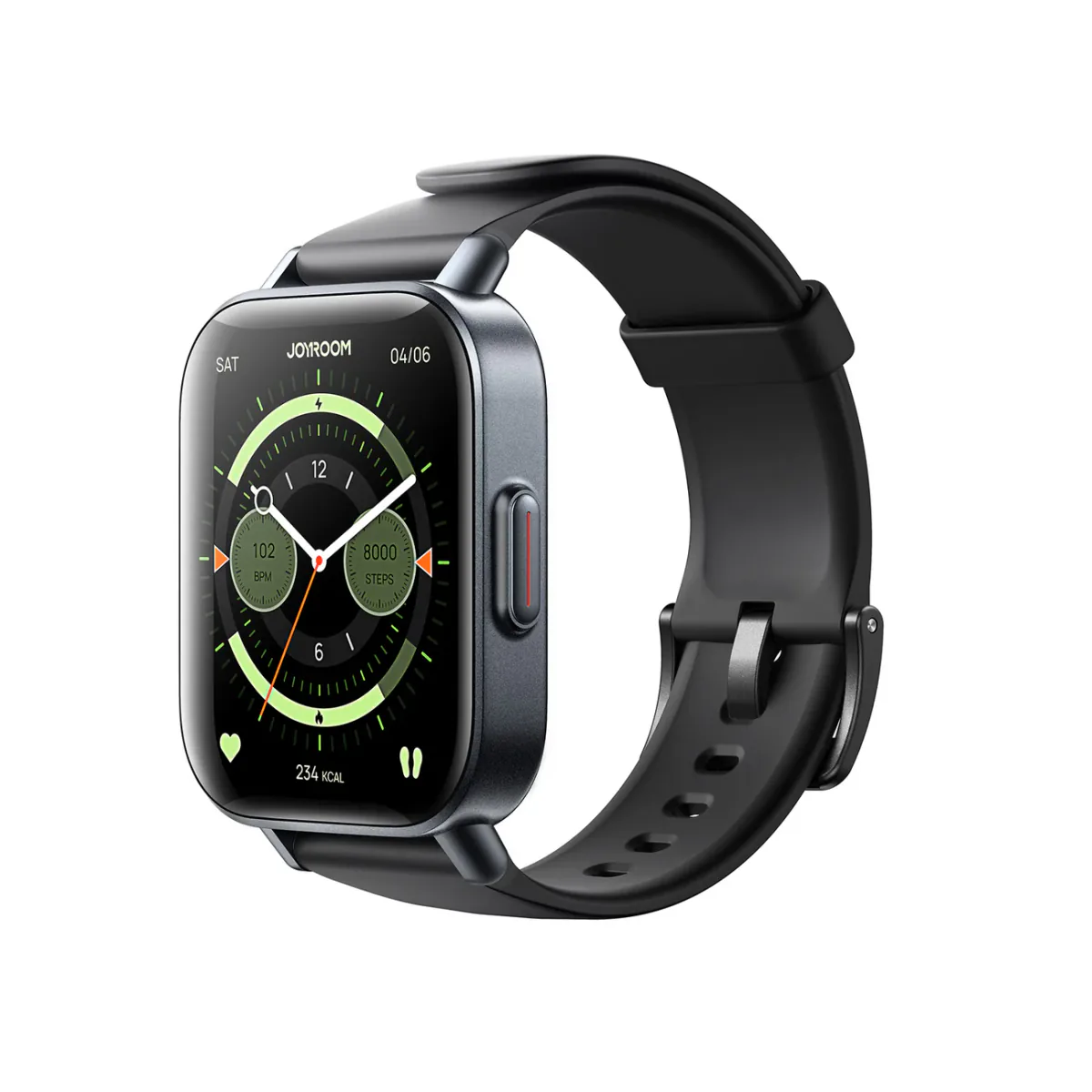
Joyroom FT3 Smartwatch | Manufacturer-Listed IP68, Sports Modes and Heart-Rate Sensor
Joyroom MagSafe Power Bank 10000mAh | 15W Wireless + 20W Wired | Kickstand
Joyroom 30W PD+QC Wall Charger | Dual USB-C and USB-A Ports
Joyroom 3-in-1 MagSafe Station | iPhone 17 + Apple Watch + AirPods | 15W | Aluminum